
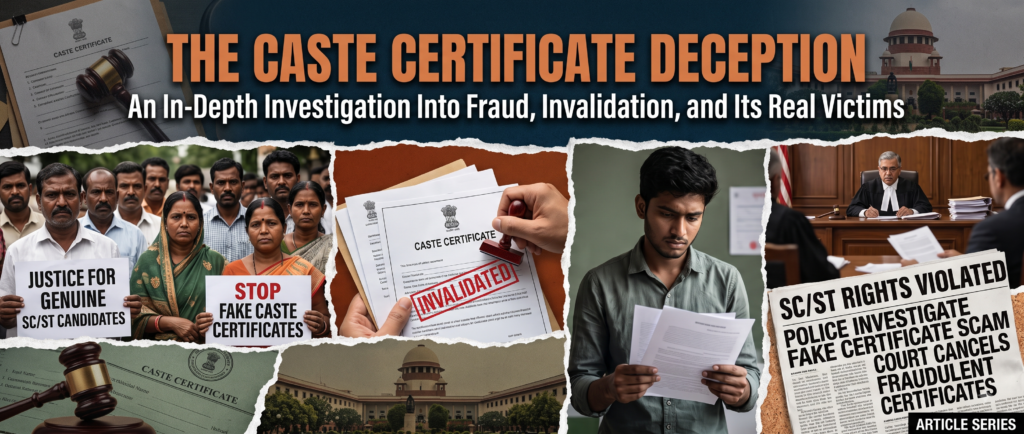
Who is Grabbing Right of Scheduled Tribes?: Case of Invalidated Caste Certificates: FCI vs Jagdish Balaram Bahira: Part 1
Basic Information of the Case
Basic Case Identification
The Supreme Court judgment in Chairman And Managing Director FCI vs Jagdish Balaram Bahira was delivered on July 6, 2017. The decision was authored by Justice Dr. D.Y. Chandrachud on behalf of a three-judge bench that also included Chief Justice Jagdish Singh Khehar and Justice N.V. Ramana. The central legal dispute revolved around non-eligible individuals using fraudulent or invalidated caste certificates to claim government jobs and educational seats meant for protected social groups. The core conflict primarily involved the Halba and Halba-Koshti communities within the Scheduled Tribes reservation category. Legally, the court examined basic constitutional guarantees of equality and affirmative action alongside extraordinary judicial powers, specifically involving Articles 141, 142, 226, 341, and 342 of the Constitution of India.
Acts and Laws Discussed
The Constitution of India, specifically Articles 141, 142, 226, 341, and 342
Constitution (Scheduled Tribes) Order, 1950
Constitution (Scheduled Castes) Order, 1950
Maharashtra Scheduled Castes, Scheduled Tribes, De-Notified Tribes (Vimukta Jatis), Nomadic Tribes, Other Backward Classes and Special Backward Category (Regulation of Issuance and Verification of) Caste Certificate Act, 2000
Equivalent citations: AIR 2017 SUPREME COURT 3271, 2017 (8) SCC 670, 2017 (5) ABR 219, (2017) 4 MAH LJ 898, (2017) 5 MAD LJ 462, (2017) 4 KER LT 31, (2017) 3 SCT 735, AIR 2017 SC (CIVIL) 2354, (2017) 7 SCALE 395, (2017) 3 LAB LN 14, (2018) 1 PAT LJR 271, (2018) 1 JLJR 273[1]
Facts of the Case
Background and Context
The primary conflict in Chairman And Managing Director FCI vs Jagdish Balaram Bahira stems from individuals obtaining government employment or admission to educational institutions against reserved quotas using invalid or fraudulent caste certificates. Over several decades, individuals belonging to the Koshti or Halba-Koshti communities secured benefits reserved exclusively for the Halba Scheduled Tribe, under the bona fide or deliberate belief that they fell within the protected category. Upon verification by statutory Scrutiny Committees, many of these caste certificates were found invalid and subsequently revoked.
The Core Issue and Procedural History
The core legal struggle emerged when employers and educational institutions initiated termination or withdrawal of benefits against individuals whose caste claims were invalidated. Affected individuals routinely challenged these actions in High Courts. A significant split in judicial approach developed during the time. While prior landmark Supreme Court decisions such as Kumari Madhuri Patil[2] mandated that an invalidated caste certificate automatically renders the underlying appointment or admission void from the beginning i.e. void ab initio, subsequent Benches frequently used extraordinary equitable powers under Article 142 of the Constitution to protect the jobs and degrees of long-serving employees or students, provided there was no clear proof of explicit fraud.
State Legislation and Conflicting Judgments
The situation became further complicated following the enactment of the Maharashtra Scheduled Castes, Scheduled Tribes, De-Notified Tribes (Vimukta Jatis), Nomadic Tribes, Other Backward Classes and Special Backward Category (Regulation of Issuance and Verification of) Caste Certificate Act, 2000.[3] Section 10 of this Act explicitly provided that any benefit obtained on the basis of an invalidated caste certificate must be withdrawn, employment terminated, and degrees revoked, irrespective of whether the claim was made with fraudulent intent. Despite this clear statutory command, various High Court decisions and conflicting Supreme Court division bench rulings continued to grant equitable relief and protect services on humanitarian grounds, leading to widespread legal uncertainty.
Reference to the Three-Judge Bench
To resolve this persistent conflict between statutory mandates and equitable protections, a batch of appeals filed by public sector employers including the Food Corporation of India and the State of Maharashtra was referred to a three-judge Bench of the Supreme Court. The Court was tasked with establishing a clear rule on whether equity or long service can shield an individual from losing their job or degree once their caste certificate is invalidated. The Supreme Court ultimately ruled that usurpation of reserved seats by non-entitled persons constitutes a fraud on the Constitution, holding that equity has no place where a benefit was secured on a false foundation, and ordering the withdrawal of all such civil benefits.
Key Legal Issues
Validity of Benefits Secured Through Invalidated Caste Certificates
The foremost issue before the Supreme Court was whether an individual whose caste or tribe certificate is invalidated by a statutory Scrutiny Committee can retain the benefits of employment or educational admission secured on the basis of that certificate. The Court examined whether such appointments or admissions are void from the beginning i.e. void ab initio or if they can be protected on humanitarian grounds after long years of service or completion of studies.
Scope and Limits of Equity Under Article 142
Another critical issue was determining whether the judiciary, particularly under Article 142 of the Constitution, can invoke equitable principles to protect jobs or degrees gained through false or unproven claims. The Court analyzed whether exercising such extraordinary equity violates the constitutional rights of genuine Scheduled Caste and Scheduled Tribe candidates who were unfairly deprived of reserved positions.
Application and Strictness of Statutory Law
The Court also addressed the interpretation of Section 10 of the Maharashtra Caste Certificates Act, 2000, which explicitly mandates the withdrawal of all benefits and termination of employment upon invalidation of a caste certificate. A key sub-issue was whether a distinction must be drawn between a deliberately fraudulent claim and a bona fide claim that simply failed verification, and whether statutory mandates override judicial discretion in granting equitable relief.
[1] Chairman And Managing Director Fci vs Jagdish Balaram Bahira available at: https://indiankanoon.org/doc/151832745/
[2] Kumari Madhuri Patil Vs. Additional Commissioner, Tribal Development [AIR 1995 SC 94], Available at: https://indiankanoon.org/doc/799713/
[3] Maharashtra Scheduled Castes, Scheduled Tribes, De-Notified Tribes (Vimukta Jatis), Nomadic Tribes, Other Backward Classes and Special Backward Category (Regulation of Issuance and Verification of) Caste Certificate Act, 2000. Available at: https://www.indiacode.nic.in/bitstream/123456789/19293/1/MH_tribal.pdf
Thanks for reading till the end!
Comment your thoughts on such cases of fake caste certificates and caste based reservations.
Share this article with others.
Bookmark this site for more case studies!