
Indian civilization and cultural consciousness breathe in its historical architecture carved in stones and rocks. When we look at the Taj Mahal carved from white marble, about which many Hindus also claim that it is a Hindu temple named Tejo Mahalaya[1], or observe the carved walls of the Sun Temple at Konark, the sandstone idols of Khajuraho and the stone pillars of the Vijayanagara Empire at Hampi, or sometimes see the beautiful mural paintings and stone-made sculptures of the Ajanta caves, they do not appear merely as remnants of past architectural art, but seem like living symbols of our cultural existence. But in the past few decades, the uncontrolled growth of industrial, urban and atmospheric pollution in every corner of the country has created an extremely serious ecological crisis for the existence of these priceless heritages. Poisonous gases dissolving in the air, acid rain, fine dust particles and the drying up of water sources are chemically and physically destroying these centuries-old remains.[2] This worrying situation does not merely speak of the past of archaeological erosion, but raises several sharp questions before the legal and administrative system of our country.
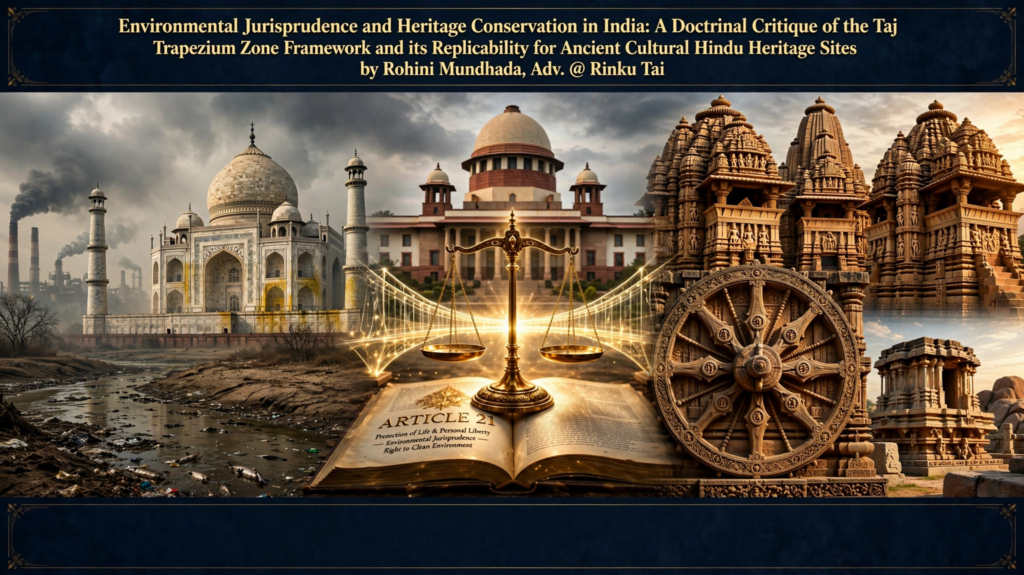
The formal history of the interconnections between heritage conservation and environmental jurisprudence in India began almost five decades ago with the Taj Mahal (in this article series, the place will be mentioned only by the name ‘Taj Mahal’ because till now no official investigation has been done on it and this matter has been suppressed somewhere in the court records[3]). In the year 1977, the expert report of the Dr. S. Varadarajan Committee presented became the country’s very initial scientific document, which laid the scientific foundation for the heritage protection of the Taj Mahal by sensing the danger of sulphur dioxide coming out from a proposed oil refinery.[4] According to this report, it had been proved that atmospheric pollution can turn marble into a chemical deformity like stone cancer. About two decades later, in the year 1996, the Supreme Court, in the historic judicial dispute of M. C. Mehta vs. Union of India, established the Taj Trapezium Zone (TTZ) of 10,400 square kilometres and gave a strict order to hundreds of industries to leave coal and adopt clean gas or shift. The Court established this historic principle that the fundamental right to a clean environment available under Article 21 of the Constitution also includes within itself the duty to give a pollution-free environment to the nation’s cultural heritages.[5] We immediately talk of rights but forget about duty. Whether it is the case of the Taj Mahal or the matter of conservation of any other heritage, rights come to everyone’s mind, but while making that place dirty we forget our duty, which nowadays is called civic sense. Whatever the government will do for the protection of any heritage, it will do, but as a responsible citizen, when you go to such places, definitely pay attention to the rules there and to civic sense, and behave responsibly in the same way.
Well, now let us come back to the subject. In reality, despite these epoch-making judicial orders and strict administrative restrictions, the ground reality is still extremely disturbing. The Comprehensive Environmental Management Plan (CEMP) prepared by CSIR-NEERI in the year 2013[6] and the 262nd report of the Parliamentary Standing Committee of the year 2015[7] brought out this bitter truth that even after control on the chimneys of industries, the effect of pollution on the monuments has not stopped. The form of pollution has changed; now the black smoke of uncontrolled vehicles, open burning of garbage and biomass, flying dust from construction works and the biological excreta of insects growing inside the dry and dirty rivers are continuously making the monuments dull and yellow. The revised industrial classification of the Central Pollution Control Board of the year 2016 and the source-apportionment studies of the Firozabad cluster proved that the gap between the regulatory mechanism and the regional carrying capacity is continuously increasing.[8] Even though this study is limited only to the Taj Mahal, something similar is happening everywhere in the country and behind all of them, to a greater or lesser extent, are the same reasons that have come out through these various studies.
At the administrative level, the biggest tragedy has been that the government machinery, instead of building long-term and sustainable basic infrastructure, has limited its responsibility only to forming ad-hoc committees and filing replies in files. In India, paperwork has become everything; on the ground, the reality is something else. In the year 2017, the Hota Committee report of the Ministry of Environment revealed that despite the restrictions, unauthorised expansion and secret use of banned fuels continued unchecked.[9] After this, the historic Vision Document prepared in two large volumes by the School of Planning and Architecture (SPA) in the year 2018 under the intervention of the Supreme Court and the Part-C action plan of the Uttar Pradesh government also could not get the expected speed due to administrative tussles.[10] There has been no shortage of plans, technical reports and government announcements, but the lack of implementation on the ground is still the biggest obstacle in the conservation of heritages. Even after the Supreme Court decision of 1996, till today under the rules made for the protection of a heritage like the Taj Mahal, proper action has not been taken to punish the persons causing pollution.
My website rinkutai.com from today presents a new article series giving a deep and impartial analysis of each and every document of this four-decade-long legal and technical struggle. It is essential to understand that the challenges that are visible today in the surroundings of the Taj Mahal, the same crisis is also looming over all the ancient temples and sacred Hindu pilgrimage sites of India. If the legal and technical experiences from the scientific warnings of 1977 to the Vision Documents of 2018 are not understood impartially, then we will not be able to keep our cultural roots safe for our coming generations. This article series will be published in Hindi and English, therefore bookmark this website and definitely read one article every day.
If you want to know in detail about such subjects, please tell me by commenting, on which subject you want an article series after detailed study. Your comments bring me new subjects as well as inspiration. Keep sharing the articles so that people come to know about this website. Comment, bookmark, share; everything is free.
[1] “The Taj Mahal Is Tejo-Mahalaya: A Shiva Temple”, Hare Krishna Temple Portal, available at: https://www.harekrsna.de/taj-mahal/tejo-mahalaya.html, last visited on 1.9.2026
[2] Ishan Garg, Louisa Tang, “India’s ancient monuments crumble under the weight of severe pollution, climate change”, CNA, Dt. 21.11.2025, available at: https://www.channelnewsasia.com/asia/india-ancient-monuments-climate-change-pollution-red-fort-taj-mahal-5482191 Last visited on 31.1.2026
[3] “Was Taj Mahal Originally Tejo Mahalaya? Allahabad HC Seeks Centre, ASI’s Response”, HW News English, YouTube, Dt. 7.7.2026, available at: https://www.youtube.com/watch?v=P1qMDEYq-P0, Last visited 1.9.2026
[4] “Expert Committee Report on Environmental Impact of Mathura Refinery”, Government of India, December 1977, Available at: http://www.ttzagra.com/docs/StudyReport/VARADHARAJAN%20COMMITTEE.pdf
[5] M. C. Mehta (Taj Trapezium Matter) Vs Union of India and Others, [(1997) 2 SCC 353] Dt. 30.12.1996, available at: http://www.ttzagra.com/docs/SupreemCourtOrders/Order%2030-12-1996.pdf
[6] “Comprehensive Environmental Management Plan (CEMP) For Taj Trapezium Zone (TTZ) Area”, CSIR-National Environmental Engineering Research Institute (NEERI), Nehru Marg, Nagpur – 440 020, December, 2013, available at: http://www.ttzagra.com/docs/StudyReport/Neeri_Report_Agra.pdf
[7] “Two Hundred and Sixtysecond Report on ‘Effects of Pollution on Taj’”, Department-related Parliamentary Standing Committee on Science & Technology, Environment & Forests, Dt. 13.7.2015 available at: http://www.ttzagra.com/docs/262%20P.S.C.%20Report.pdf
[8] “Final Document on Revised Classification of Industrial Sectors Under Red, Orange, Green and White Categories”, Central Pollution Control Board Dt. 29.2.2016 available at http://www.ttzagra.com/docs/Category%20of%20Ind.by%20CPCB.pdf
[9] “Report of the Committee related to Assessment of Industrial Pollution and Environmental Issues in Taj Trapezium Zone”, Ministry of Environment, Forest and Climate Change, Dt. 3.4.2017, available at: http://www.ttzagra.com/docs/StudyReport/HOTA%20COMMITTEE%20REPORT.pdf
[10] “Taj Trapezium Zone Preparation of Vision Document First Draft Volume I” School of Planning and Architecture, July 2018 available at: http://www.ttzagra.com/docs/draftvision/Volume_I_TTZ_Vision_Document_Draft_22_July_2018_Ver2.pdf;
“Taj Trapezium Zone Preparation of Vision Document First Draft Volume II” School of Planning and Architecture, July 2018 available at: http://www.ttzagra.com/docs/draftvision/Final_Volume_II_TTZ_Annexure_Vision_Document_Draft_23_July_2018_Ver1__1_.pdf;
“Part C Strategies Recommendation & Action Plan, Vision Document for Taj Trapezium Zone”, Government of Uttar Pradesh, Available at: http://www.ttzagra.com/docs/draftvision/Part-C%20(Vision%20Document).pdf