
Government Decision to Establish Refinery in Mathura in the 1970s and Formation of the Varadarajan Committee
In the beginning of the 1970s, the Central Government had taken the decision to establish a large public sector oil refining project in Mathura to meet the energy and industrial needs of north-western India. At that time, due to the Green Revolution in Punjab, Haryana, Rajasthan and western Uttar Pradesh, the demand for petroleum products, fertilizers and diesel was increasing rapidly in the agriculture and transport sectors. Bringing imported crude oil from the ports of Gujarat to the interior parts of north India through pipelines was considered practical from the economic and logistical point of view. Where demand had increased, Mathura is in the middle of that entire region as per the government’s belief. Mathura was considered the most suitable place for establishing the refinery as the centre of national highways, railway network and water resources of the Yamuna river.[1]
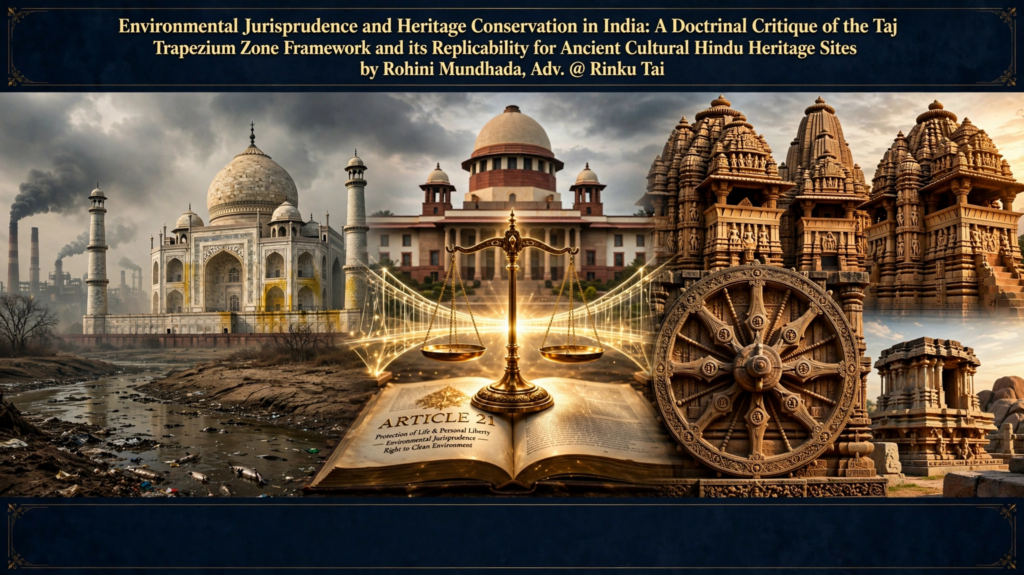
As soon as the announcement of this large petrochemical project was made, historians and environmentalists from the country and abroad raised serious concerns regarding the chemical adverse effects on the Taj Mahal and the ancient buildings around it. Many people also submitted representations to the government on this subject at their own level. For the scientific solution of this dispute, the Government of India formed a high-level expert committee in the year 1974 under the chairmanship of Dr. S. Varadarajan. The main task of this committee was to study the atmospheric dispersion of the smoke coming out from the Mathura refinery, especially sulphur dioxide (SO2) gas, and to suggest measures for the safety of historical monument Taj Mahal.[2] This report is one of those early documents of India’s environmental protection movement which helped in creating a scientific framework.
Conclusions of the Varadarajan Committee Report and the Government’s Final Decision
In the Varadarajan Committee report presented in December 1977, recommendation was not made to shift the refinery to any other state or distant place. Keeping in mind the heavy financial investment already made in the project till that time and the economic priorities, the committee gave technical permission to establish the plant in Mathura itself. However, the committee had given this permission with some very strict technical conditions and environmental improvements. These conditions, improvements and suggestions which were in this 1977 report can still be useful in fighting the enemy in the form of pollution if they are followed strictly.
The Varadarajan Committee directed that sulphur recovery units be established by making changes in the design of the refinery, only low-sulphur heavy fuel or gas be used in electricity and steam production, and the old coal power houses and steam engines of railway yards located in the area around Agra be closed.[3] The then government accepted these technical recommendations of the Varadarajan Committee and instead of changing the location of the refinery, took the final decision to build it at the same place, as a result of which the commercial operation of the Mathura Refinery started in January 1982.[4] This refinery gave employment to many people at that time. Even today, many projects are undertaken, large factories are started, large centres like refineries are built by giving the argument that employment will increase, but is an environmental impact assessment done every time by forming a committee like the Varadarajan Committee before increasing industrialisation on a large scale? This is a necessary action which the government should take every time before increasing industrialisation on a large scale, so that an estimate can be made of what effect the increasing pollution will have and measures to deal with this problem can be taken from time to time with great strictness.
Present Status of Mathura Refinery Today and the Taj Trapezium Zone (TTZ)
Since the government had already invested a lot in this plan at that time, the Mathura Refinery is still operating at full capacity at its original place, that is, in Mathura on the Delhi-Agra National Highway (NH-19). This complex is about 40 kilometres from the Taj Mahal, quite close to the Taj Mahal, working under the management of Indian Oil Corporation Limited (IOCL) in the north-west direction.[5] Since the location of the refinery was never changed, the question of pollution reducing at any new place or the effect of the new refinery on the temples there does not apply. But even today, environmental harm is being caused according to the estimate of pollution that was made at that time. Forming a committee and making a report is necessary but the suggestions given in the report should also be followed, which has been happening almost negligibly in India due to the laxity of the government machinery.
This large refinery has today become the largest industrial establishment located within the entire Taj Trapezium Zone (TTZ) of 10,400 sq. km. It can neither be removed nor closed because petroleum products are necessary for the economic progress of the country. Importing crude oil becomes cheap and economical, that is why having our own refinery in the country is necessary.[6] Due to the historical orders of the Supreme Court of the year 1996 and continuous legal monitoring, technical improvements have been made in the Mathura Refinery from time to time, the use of natural gas has been increased and modern hydrocracker plants have been installed. [7] Despite this, being a large oil refining complex, the fine gases and volatile organic compounds (VOCs) emitted from it are still an integral part of the atmosphere of this sensitive Regional Airshed.[8] In India in 2026, a total of 23 oil refineries are operational. Due to all of them, somewhere or the other, effect is being caused on cultural heritage, on human settlements around, on other living beings.[9] But if they are closed then many jobs will go away, the country will have to bear a greater burden of importing refined petroleum products which will further increase inflation. But some measures should be found at the scientific level for environmental protection, some responsibility should be taken by all as responsible citizens. If we use petroleum and the products derived from it with complete thrift at our own level then there will be two benefits; first, less money will be spent from your pocket, second, environmental protection will happen.[10]
Corrosive Effect of Cumulative Pollution on the Taj Mahal and the Ancient Hindu Temples of Braj Mandal
This protected area of 10,400 sq. km. is not limited only to the Taj Mahal, but the entire sacred land of Braj Mandal comes within this geographical range. This place holds special faith for Hindus. Within this periphery are located the ancient Shri Krishna Janmabhoomi complex and Dwarkadhish Temple of Mathura. Along with this, the historical temples of the 16th and 17th centuries of Vrindavan, such as Shri Govind Dev Ji Temple, Madan Mohan Temple, Jugal Kishore Temple and Radha Vallabh Temple etc. And the ancient stone chhatris of Govardhan, Barsana, Nandgaon and Mahavan are also in direct contact with this airshed. Many villages of Agra, Firozabad, Mathura, Hathras, Etah of Uttar Pradesh as well as Bharatpur district of Rajasthan have come under the effect of this refinery and effect has fallen on the historical and religious heritage here as well as on life.
From the technical point of view of religious and historical heritage conservation, this is an extremely serious crisis because these ancient temples of Vrindavan and Mathura are mainly carved from porous red sandstone.[11] Compared to the dense Makrana marble of the Taj Mahal, sandstone is much more sensitive and absorbent to atmospheric chemicals and moisture. When the acidic compounds of sulphur and nitrogen present in the atmosphere get deposited on the carved surfaces of these temples along with fog, moisture or rain, chemical corrosion starts inside the stones.[12] Reports have also been made for the conservation of the Taj Mahal, cases have also been filed, zone has also been marked, authorities have also been established, specially funds are also given. But what about the Hindu temples which are bearing the brunt of this industrialisation. For such temples, government assistance is a distant thing, but due to the policy of government control over Hindu temples, whatever offerings come and the property is there, the government takes its full use in other works leaving the temple and Hindu religion.[13] This is injustice with Hindu temples. The matter is not only of the temples that come in the Taj Trapezium Zone (TTZ), the matter is of all those temples which are under government control along with the blow of increasing pollution in the name of development and cannot even stop the erosion happening due to pollution.
Due to this chemical process on sandstones and on every other kind of construction, the layers of stones start peeling off (Exfoliation), the fine edges of ancient artworks get worn away and deep black-brown corrosive spots emerge on the stones.[14] This condition is called ‘Stone Leprosy’ in scientific and archaeological language.[15] Apart from this, the uncontrolled smoke of heavy vehicles in this entire area, the dirty water of factories and cities mixing in the flow of the Yamuna river, dust of construction works and industrial emissions together create a Cumulative Pollution Load. Along with this, increasing noise pollution is having a separate effect. As a result, despite the technical measures suggested by the Varadarajan Committee, today these invaluable and historical Hindu temples along with the Taj Mahal are continuously struggling with the crisis of atmospheric corrosion and slow destruction. For the Taj Mahal at least the government gives some funds, but funds are not given to the temples.
[1] Dipankar Day, “Indian oil industry: Faultline in refining”, Millennium Post, Dt. 6.2.2022, Available at: https://www.millenniumpost.in/sundaypost/in-retrospect/indian-oil-industry-faultline-in-refining-467362, last visited on Dt. 3.2.2026
[2] “Expert Committee Report on Environmental Impact of Mathura Refinery”, Government of India, December 1977, Available at: http://www.ttzagra.com/docs/StudyReport/VARADHARAJAN%20COMMITTEE.pdf
[3] Ibid 12
[4] “Mathura Refinery”, Indian Oil Corporation Ltd., available at: https://iocl.com/mathura-refinery, Last visited on 1.2.2026
[5] Sunita Narain, Aruna P Sharma, Jyotsna Singh, “Daunting journey”, Down To Earth, Dt. 30.4.2015 available at: https://www.downtoearth.org.in/urbanisation/daunting-journey-49613, Last visited on 1.2.2026
[6] “How Oil-Importing India Became a Global Refined-Fuel Supplier” Finnovate, Dt. 31.07.2026, available at: https://www.finnovate.in/learn/blog/how-oil-importer-india-became-global-fuel-supplier Last visited on 14.8.2026
[7] “Mathura Refinery”, Indian Oil Corporation Ltd., available at: https://iocl.com/mathura-refinery, Last visited on 1.2.2026
[8] Mukesh Sharma, “Air Quality Assessment, Trend Analysis, Emission Inventory and Source Apportionment Study in the City of Agra”, IIT Kanpur, December 2021, available at: https://prana.cpcb.gov.in/ncapDashboard/downloadEmissionFiles/Agra.pdf
[9] Mukesh Sharma, “Identification of Air Pollution Sources and their Contribution to Ambient Air in the City of Varanasi employing Source Apportionment Study and Developing Clean Air Action Plan”, IIT Kanpur, March 2024, Available at: https://prana.cpcb.gov.in/ncapDashboard/downloadEmissionFiles/Varanasi.pdf
[10] The Grantham Institute, “9 things you can do about climate change”, Imperial, available at: https://www.imperial.ac.uk/stories/climate-action/ Last visited on 13.9.2026
[11] Arjun Kumar, “From the land of Krishna: History nuggets in Vrindavan”, First Post, Dt. 17.8.2025, available at: https://www.firstpost.com/opinion/from-the-land-of-krishna-history-nuggets-in-vrindavan-13925567.html, Last visited on 3.2.2026
[12] Shilpa Raina, “Ancient stones meet modern pollutants: How air pollution is eroding India’s heritage monuments”, Scroll, Dt. 31.12.2025, available at: https://scroll.in/article/1089592/ancient-stones-meet-modern-pollutants-how-air-pollution-is-eroding-indias-heritage-monuments, Last visited on 2.2.2026
[13] Rati Agnihotri, “State control of Hindu temples in India: A Historical Perspective”, Stop Hindu Dwesha, Dt. 27.7.2024, available at: https://stophindudvesha.org/state-control-of-hindu-temples-in-india-a-historical-perspective/, last visited on 3.2.2026
[14] Youzhen Yang, Wei Liu, Qingqing Lin, Jinghua Qi, Meixi Liu, Hui Ma & Yuhao Xia, “Weathering characterization and evaluation of sandstone relics in Helan Pass via the fuzzy-AHP” Heritage Science, 2025, available at: https://www.nature.com/articles/s40494-025-01680-4.pdf, last visited on 4.2.2026
[15] Rachana Shrivastava, “Indian Heritage Monuments Are Crumbling Silently But Visibly, Warn Experts”, Gnanaganga, Dt. 28.5.2025, available at: https://gnanaganga.alliance.edu.in/server/api/core/bitstreams/8652a79d-41a1-4fe1-a64d-1c72e5f19adf/content, last visited on 5.2.2026
Previous Articles of the Series